Heat-adjusted pace calculator
Heat slows everyone, but the studies disagree on how much, so this gives a range between two published models instead of one confident number. Use it both ways: what a hot race was really worth, or what to aim for when the forecast is warm.
Race
Sky
Worth in cool air
3:19:49
to 3:23:04
The heat cost you 6:56 to 10:11.
- Pace
- 4:44 - 4:49/km · 7:37 - 7:45/mi
- Running Writings model
- 3.4%
- Mantzios 2022 model
- 5.1%
- WBGT, estimated
- 23 °C
- Dew point
- 19 °C
What heat adds to a 4:00:00 marathon
Minutes and seconds added, low to high, in cloud or shade. Full sun adds more.
| Air | 40% humidity | 60% humidity | 80% humidity |
|---|---|---|---|
| 15 °C 59 °F | +0:01 - +0:16 | +0:22 - +1:45 | +0:25 - +3:12 |
| 20 °C 68 °F | +1:59 - +4:21 | +2:58 - +6:07 | +3:07 - +7:46 |
| 25 °C 77 °F | +4:23 - +8:26 | +6:34 - +10:29 | +8:27 - +12:20 |
| 30 °C 86 °F | +6:55 - +12:31 | +10:43 - +14:51 | +15:35 - +16:54 |
| 35 °C 95 °F | +9:27 - +16:36 | +15:03 - +19:13 | +21:28 - +23:09 |
What heat adds to a 50:00 10K
Minutes and seconds added, low to high, in cloud or shade. Full sun adds more.
| Air | 40% humidity | 60% humidity | 80% humidity |
|---|---|---|---|
| 15 °C 59 °F | +0:00 - +0:01 | +0:05 - +0:06 | +0:05 - +0:12 |
| 20 °C 68 °F | +0:15 - +0:25 | +0:21 - +0:37 | +0:26 - +0:39 |
| 25 °C 77 °F | +0:28 - +0:55 | +0:34 - +1:22 | +0:39 - +1:46 |
| 30 °C 86 °F | +0:40 - +1:26 | +0:46 - +2:14 | +0:51 - +3:15 |
| 35 °C 95 °F | +0:50 - +1:58 | +0:56 - +3:08 | +1:00 - +4:49 |
How it works
Two models, one range
The low and high ends come from two models built on the same 1,258 races (Mantzios et al. 2022): John Davis's temperature and humidity model, and the paper's own line for well-trained marathoners, or for elite 10,000 m runners on the 5K and 10K.
Why humidity matters
Sweat cools you only when it evaporates. Humid air slows that, so 27 °C at 80% humidity costs far more than 27 °C dry. The dew point is the simplest single number for it.
Sun and WBGT
Race medics use WBGT, a heat index that adds sun to temperature and humidity. It is estimated here from your numbers; full sun adds about 1.4 °C to it.
Where the numbers come from
Mantzios et al. 2022, Medicine & Science in Sports & Exercise, equations from its supplement Table S7, read against WBGT 10 °C. The Running Writings heat model by John Davis (2025, MIT licence), fitted on the same open data. WBGT estimated with the Stull 2011 wet bulb. Studies disagree on whether slower runners lose more (Ely 2007 and Vihma 2010 say yes, El Helou 2012 says no), so no ability adjustment is made. Mantzios 2022 · Running Writings
Put the hot day on the photo
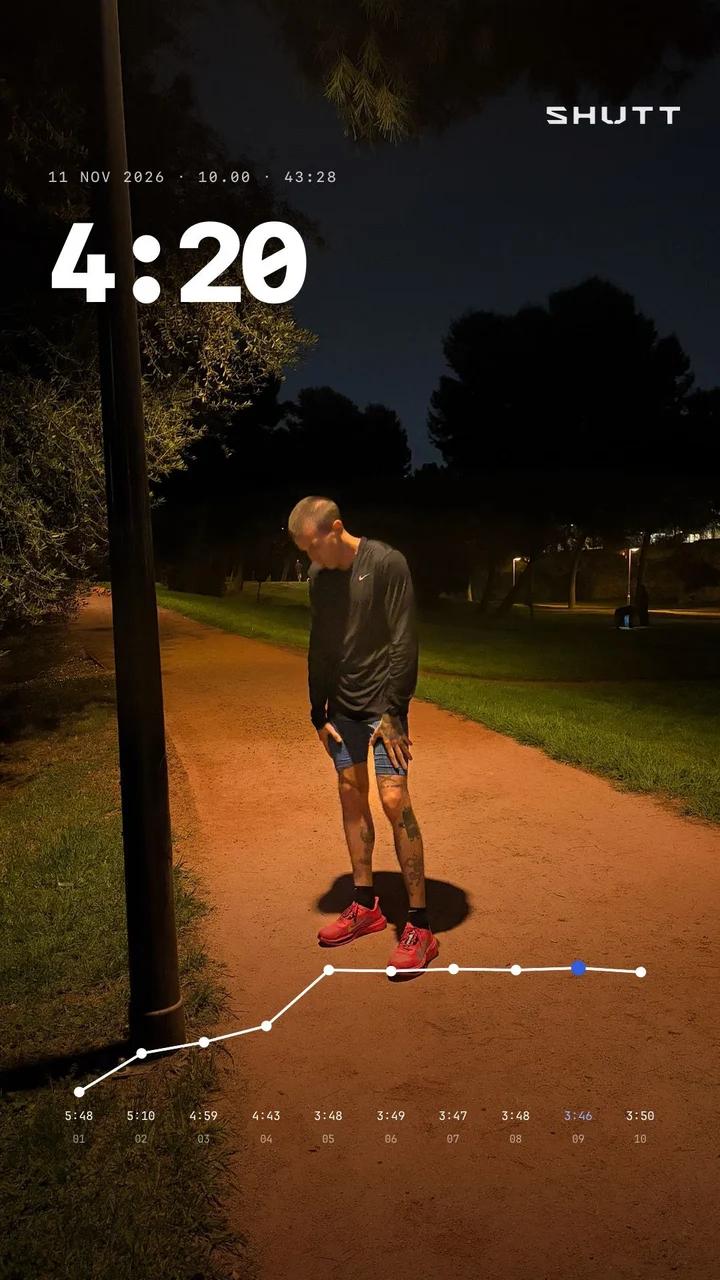
SHUTT (we make it) reads your run from Strava and sets your time, pace and splits on your own photo, ready for an Instagram Story. iPhone.
Get SHUTT on the App Store
Questions
How much slower should I run a marathon in the heat?
For a 4:00 marathon at 25 °C (77 °F) and 60% humidity, 6:34 to 10:29 slower, depending on the model. At 30 °C and humid, much more. Starting slower is cheaper than paying for it at 30K.
How much does heat slow a 10K?
A 50:00 10K at 30 °C (86 °F) and 70% humidity costs 0:48 to 2:43. Heat costs less over short races than over a marathon, and the research is thinner.
What is the best temperature for a marathon?
Mantzios 2022 finds the best range at 10 to 17.5 °C air (7.5 to 15 °C WBGT); El Helou 2012 finds it cooler, 4 to 10 °C (39 to 50 °F). Above that, every degree adds time.
Does humidity matter more than temperature?
Both count. At 27 °C (81 °F), a 4:00 marathon loses 5:23 to 10:04 at 40% humidity, and 11:56 to 14:38 at 85%.
Do slower runners lose more time in the heat?
The studies disagree. Ely 2007 and Vihma 2010 find slower runners lose more; El Helou 2012 finds no difference by ability. So this calculator makes no ability adjustment and shows a range instead.
Pace calculator·Boston qualifier check·Free running and cycling tools